
Posted on July 7, 2026 by Dong Quanyue|Qingdao Vocational and Technical College of Hotel Management
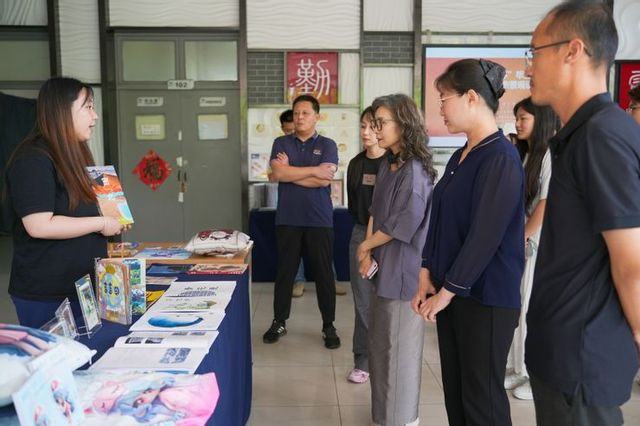
On July 2, the 10th Boyi Cup Graduation Design Exhibition and the 2026 Qingdao Urban Landscape Design Exchange officially opened in the lobby of the School of Arts.
The event gathered teachers and students to view the graduation achievements. Student designers presented their creative concepts. Participants conducted in-depth discussions on innovative art and design education as well as the integration of industry and education in urban landscape design, boosting professional exchanges and educational innovation.
The exhibition featured more than 200 outstanding student works covering four major disciplines: interior design, product design, advertising design and digital media design. Adopting a dual exhibition mode of online screen display and offline physical exhibition, the event fully demonstrated students’ artistic creativity and practical capabilities, and showcased the school’s accumulated teaching experience and fruitful achievements in integrating industry and education.
Highlighting digital features, the online exhibition integrated cutting-edge digital technologies with humanistic connotations, breaking traditional design paradigms and reflecting students’ innovative thinking and new vitality in digital art creation empowered by AI technology.
Rooted in local Qingdao culture, the offline exhibits transformed traditional regional cultural symbols into aesthetic, practical and innovative cultural and creative works through modern and youthful design perspectives, fully embodying students’ solid professional competence.
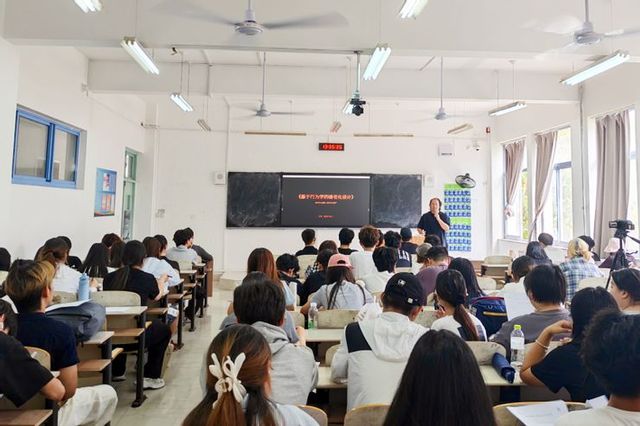
During the concurrent urban landscape design exchange, Professor Qian Zhike from Qingdao University of Technology delivered a special lecture on environment-friendly aging-adaptive design. The lecture systematically interpreted policy trends, core concepts, design procedures, spatial principles, scenario implementation, material application and typical cases. It corrected one-sided public perceptions of barrier-free design and provided systematic and professional guidance for all participating teachers and students.
Driven by real industry demands, the event reflected students’ acute social observation, solid professional skills and innovative awareness. It also built a high-quality communication platform for teachers, students and industry experts, broadening students’ professional horizons and improving their professionalism and employability.
In the future, the School of Arts will further optimize its talent training model, deepen industry-education integration, explore the integration of digital technology and artistic creation, and cultivate high-quality innovative art and design talents to empower the development of the cultural and creative industry.