
Posted on Nov.9, 2026 by Dong Quanyue|Qingdao Vocational and Technical College of Hotel Management
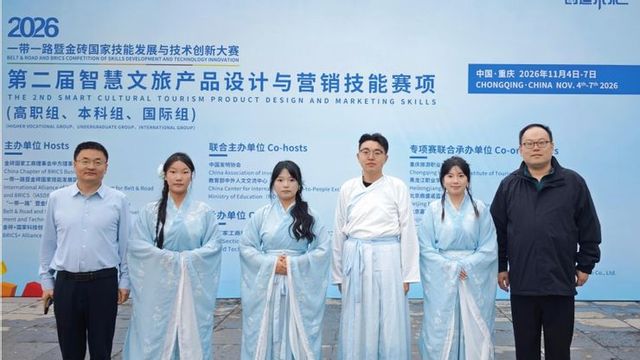
The National Final of the 2nd Smart Cultural Tourism Product Design and Marketing Competition under the 2026 Belt and Road & BRICS Skills Development and Technological Innovation Competition was held in Chongqing from November 3 to 7.
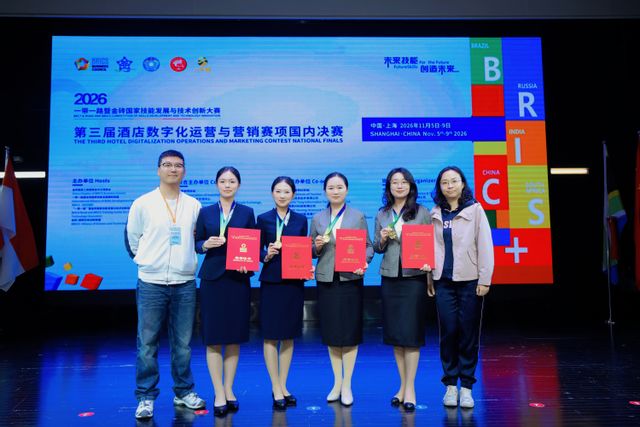
The competition saw our team consisting of Chen Jingze, Ma Xiaoying, Zhang Xinru and Wang Ziying from the School of Cultural Tourism rank first in its parallel group and claim the first prize in the higher vocational group. The college was awarded the Excellent Organization Award.
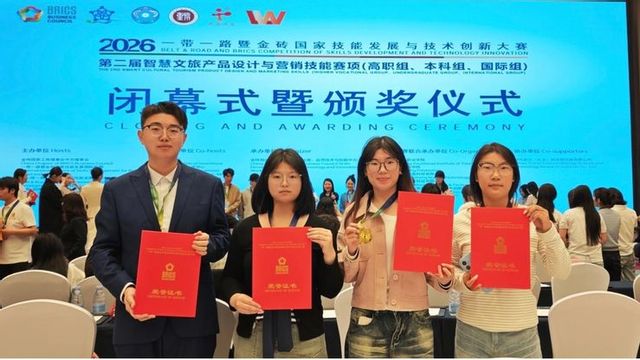
Hosted by the Chinese Council of the BRICS Business Council and the Belt and Road & BRICS Skills Development International Alliance, the competition was divided into undergraduate, higher vocational and international groups. More than 230 teams with over 400 contestants from over 20 provinces, autonomous regions and municipalities across China took part.
The contest covered scheme design and on-site presentation, assessing teams’ capabilities in creative cultural tourism design, market analysis, digital technology application, marketing planning and roadshow delivery. It encouraged contestants to integrate AIGC, big data and other digital technologies into tourism development, advocate green and sustainable cultural tourism, and foster versatile skilled talents for the digital transformation of the cultural tourism industry.
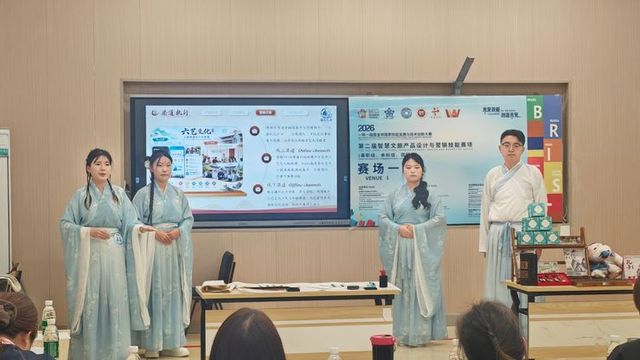
Titled Confucius Inherits the Six Arts, Bridging Antiquity and Modernity — A Date with Chinese Culture for Global Youth, the team’s entry opens with a multilingual greeting of “Hello, Confucius”. It develops youth-oriented study tour courses themed on the Six Arts: rites, music, archery, charioteering, calligraphy and mathematics. The product features an interactive digital avatar of Confucius, immersive experiences of rituals, calligraphy and bamboo slip carving. Supported by integrated online-offline marketing and live streaming on international platforms, it invites young people worldwide to explore Chinese culture and supports the development of distinctive inbound tourism products.
During preparation, college leaders provided guidance and resources. The School of Cultural Tourism coordinated training and mock presentations. Guided by the integration of industry and education, the team kept refining their proposal, marketing plan and performance based on competition rules and local cultural tourism resources.
The college will continue to promote teaching and learning through competitions, improve the talent training system of the provincial Double High-level high-quality tourism specialty cluster, advance digital reform in curriculum and teaching, and cultivate innovative cultural tourism professionals with solid cultural foundations and digital expertise.