
Posted on Sep.30, 2026 by Dong Quanyue|Qingdao Vocational and Technical College of Hotel Management
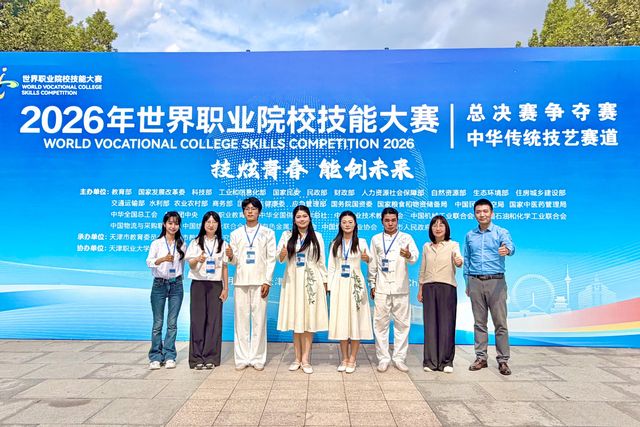
The final competition of the Traditional Craft Track (Higher Vocational Group) of the World Vocational Colleges Skills Competition 2026 was held in Tianjin from 24 to 29 September.
Our team, comprising students Song Yunxi, Li Shuchang, Li Huaqi and Zhao Li from the School of Arts, won the gold medal—a major breakthrough for our college in this newly added national contest track.
Guided by the industry–education integration philosophy of industry raising the question, college and enterprise answering together, and market grading the result, the team pursued innovative approaches to intangible cultural heritage (ICH) revitalization and explored the folk culture of Jiaodong steamed bun molds (bobo kazi). Their project, Kanmai Voyage: Living Heritage and Global Promotion of Steamed Bun Molds, targets pain points including high learning thresholds, loss of patterns, interrupted inheritance and shrinking markets. Centering on pear-wood mold carving, it integrates hand carving, VR digital workshops, interactive experience cabinets and an AI pattern-customization mini-program. The team built an ICH pattern database, established standardized carving procedures, and improved carving tools to enable two-way linkage between hand carving and digital workshops, creating an integrated online-and-offline heritage experience while balancing craftsmanship inheritance, digital empowerment and cultural product development.
As a new track of the competition—upgraded from the National Vocational College Skills Competition and hosted by the Ministry of Education—it comprehensively assesses contestants' craftsmanship, digital application, teamwork and cultural innovation.
During preparation, college leaders visited the training site, and Vice President Jiang Lingling travelled to Tianjin to encourage the team. The Academic Affairs Office coordinated resources and organized rehearsals, while faculty mentors guided every stage. Despite tight schedules, the students worked day and night to refine their carving and digital demonstrations.
The School of Arts will turn this achievement into educational resources, deepen its promoting teaching, learning and research through competitions model, and continue nurturing design talents with both craftsmanship and innovation to support ICH dissemination and high-quality regional cultural industry development.